michael86 wrote: ↑Tue Oct 19, 2021 1:12 pm
Hi Hotrodder, Have a look at this link, it shows the different symbols on the interrupteur differentials denoting the types.
Type AC
Resistive, capacitive, inductive loads
Immersion heater, oven / hob with resistive heating elements, electric shower, tungsten / halogen lighting
Type A
Single phase with electronic components
Single phase inverters, class 1 IT & multimedia equipment, power supplies for class 2 equipment, appliances such as washing machines, lighting controls, induction hobs & EV charging"
So an induction hob goes to a type A and one with resistive elements would go to a type AC.
My idea of one type for wet and one type for dry loads is wrong. Seeing that from the info above a shower is fed through a type AC and a washing machine through a type A.
On my headstone it will say: Please switch off mobile phones. I'm trying to get some sleep.
I think the diversity allowed on an electric cooker is the 100% of first 10A plus 30% of the remainder. This is in the UK, France may be different. Your cooker is 9905W, which is 43A. With diversity, 10 plus 30% of 33 = 19.9A = approximately 4.6kW.
I have to agree with the other two posters, I think you need a larger supply. 4.6kW from a 6kW supply leaves very little for other appliances to be used at the same time.
I hate to disagree with Robert as he always offers such good advice, but I think today he must be feeling really optimistic.
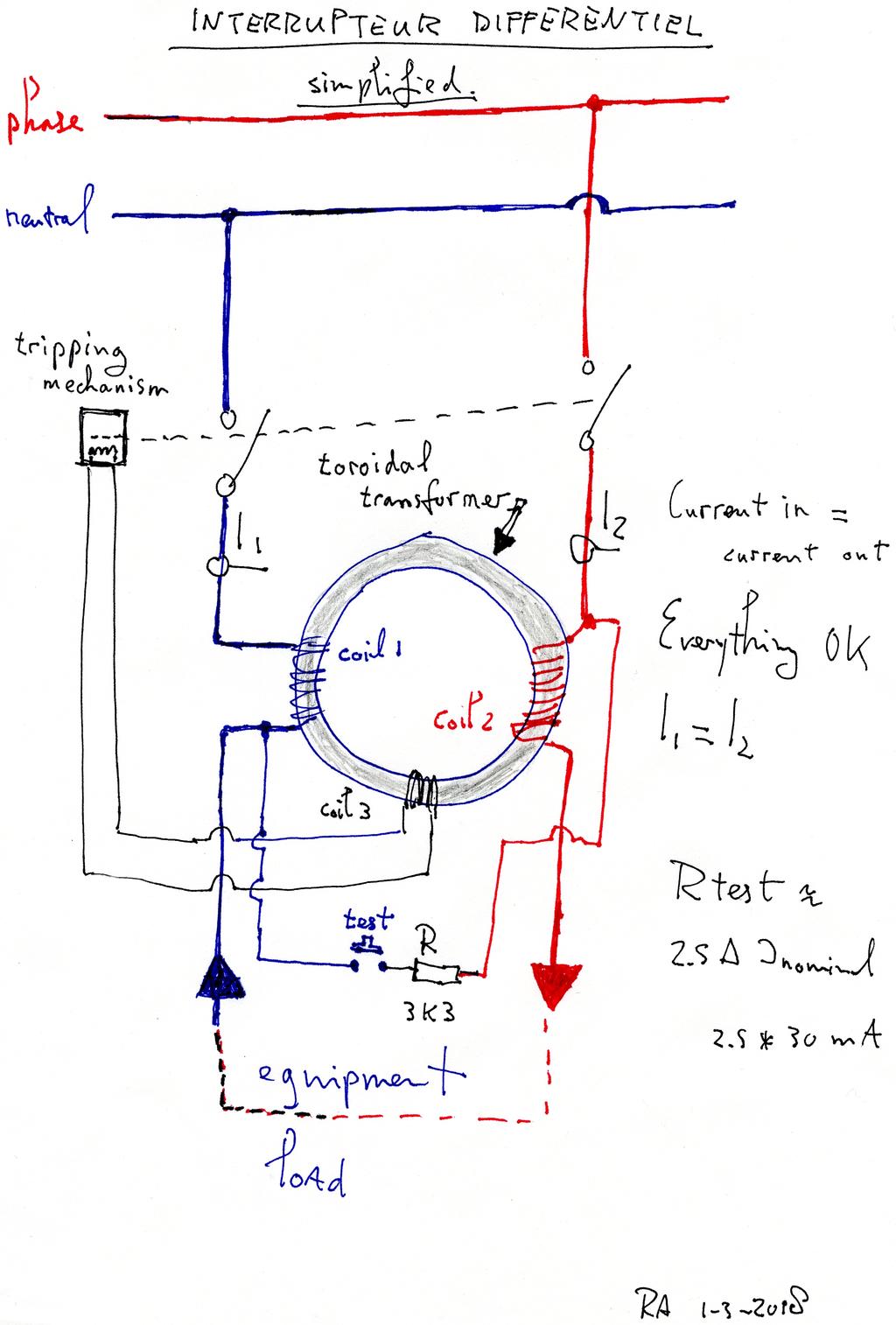
@ Hotrodder, in many member states of the EU they said goodbye to the AC type interrupteur différentiel of 30 mA many years ago. Why: modern electronic equipment with switched mode power supplies - the answer to heavy transformers - can produce rather strange non sinusoidal (fault) currents, not always detected in time by the good old old AC type.
Use of an AC type to feed an oven dangerous? No, it does have quite a lot of electronics on board these days, but no harm done when using an AC type. As long as you check them so every now and then with the little test button. With the help of a resistor inside you produce a fault current of about 75 mA: your RCD should react immediately because the current sensing transformer of the RCD notices an unbalance between two currents. Conclusion: the French name, interrupteur différentiel (ID), is not bad at all.
hughnique wrote: ↑Tue Oct 19, 2021 1:10 pm
Sue you say Robert came in with sound advice, but you say that it will be extremely difficult to run this oven effectively with such a small incoming supply, I am afraid I would have to disagree with Robert, where he gets the fact that the oven will only be operating at 50 % I am unsure, if you check the ratings originally given for each foyer, plus whatever the oven takes it will be hard to do a good old Sunday roast with veg. As for a bit of 2.5 for the last connection, is that flex or hardwire?
Why I said that is because an electric oven will during heat up be at max Kw .. which in our old oven was 3.5Kw (IIRC) .. which took a large amount of our total. We have 2 fridges, 2 freezers plus sundry other items like TV's, computers, lights which might be on at the same time as the oven .. we might need boiled water for cooking on the hob at the same time as the oven is on .. so another 2.2Kw each time.
In the evening the last thing I want whilst making our supper is the power cutting out.
Edit : Robert is right that an oven and electric rings will cut in and out after they have reached temperature .. so 50% is a possibility. But it is the other items using electricity that we forget about.
The other factor here is that a suggestion was made about using a bit of 2.5 from the wall outlet to the cooker itself, golden rule that you do not decrease the size of the conductors without providing adequate protection for that cabling so 32 amp for a bit of 2.5 is a definite no no. I really urge you to rethink this one, possibly ask edf to up the rating, on my old main switch is was only a matter of turning a wheel.
With a Linky meter it’s very easy to do it online and it happens via remote intervention. Apart from the difference in abonnement I’m not sure if there is a one off charge.
We are inclined to just be very careful to not turn on too many thirsty appliances all at the same time. Bumping up to the next abonnement is throwing money to the wind, especially after the crippling cost of a new cooker and getting a flue liner in the chimney after all these years. And bloody Xmas is coming.
On my headstone it will say: Please switch off mobile phones. I'm trying to get some sleep.
Hotrodder wrote: ↑Tue Oct 19, 2021 6:53 pm
We are inclined to just be very careful to not turn on too many thirsty appliances all at the same time. Bumping up to the next abonnement is throwing money to the wind, especially after the crippling cost of a new cooker and getting a flue liner in the chimney after all these years. And bloody Xmas is coming.
We do that. If we put our hot water heater on and run the dishwasher at the same time it throws the switch.
The trick is to have everything on timers, particularly if you are on a time based tariff . Water heater on over night, all other appliances programmed to go on at different times in the cheap period. I had it off to a fine art, then we switched to a flat tariff as there are only the two of us in the house all year and it was cheaper.